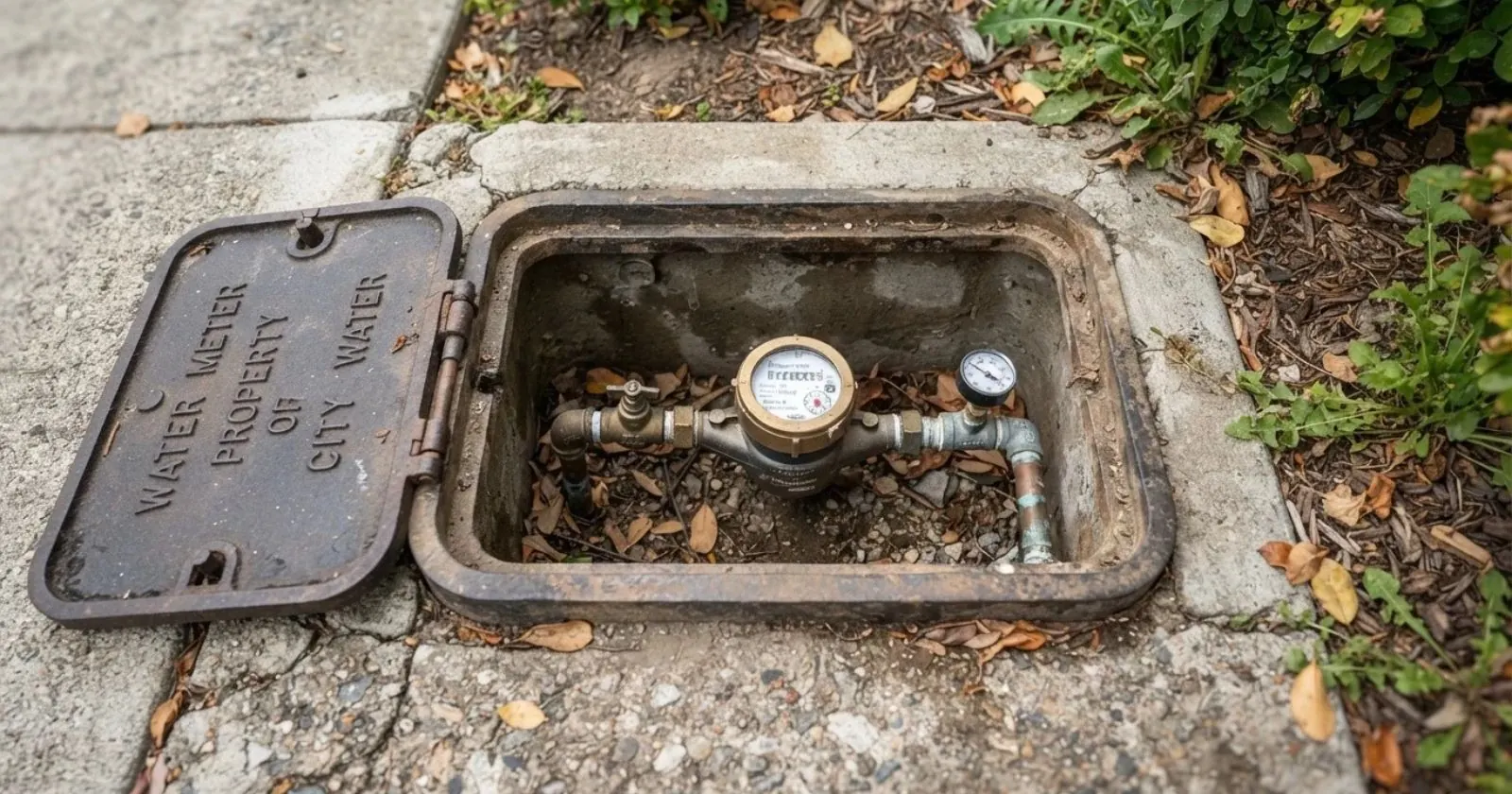
A surprise on the water bill is one of the most common reasons people call a plumber without knowing what is wrong. Nothing looks wet, nothing sounds different, but the usage number went up. The good news is that most causes can be found with a few simple tests, done in order, using nothing but your water meter and some food coloring.
It helps to know how much small leaks add up to. The typical home loses close to 10,000 gallons a year to leaks, according to EPA WaterSense estimates. Many of those leaks are silent.
Before you start: check the bill itself
Look at the number of days in the billing period and the usage in gallons, not just the dollar amount. A longer billing cycle or a rate change can raise the bill without any change in usage. Compare the same month last year too, since summer irrigation and pool top-offs naturally push usage up.
If usage in gallons really did climb, move on to the tests.
Test 1: the meter test
- Turn off every faucet, shower, and appliance.
- Set the irrigation controller to off and switch off any pool autofill.
- Make sure no toilet is refilling.
- Find the meter, usually in a box near the street, and locate the small leak indicator on the dial.
- Watch it for two to three minutes.
If the indicator is still, water is not escaping right now, and the higher bill may come from intermittent use such as irrigation. If it moves, keep going.
Test 2: inside or outside
Close the main shutoff on the house. If the meter indicator stops, the leak is inside the home. If it keeps moving, the leak is outside, on the pipe running from the meter to the house, or on an irrigation line that branches off before the house shutoff.
Test 3: the toilet dye test
Toilets are the most common silent leak. A worn flapper lets water trickle from the tank into the bowl, and the tank refills quietly every so often. You may never hear it.
- Remove the tank lid.
- Add a few drops of food coloring to the tank water.
- Do not flush for 15 to 20 minutes.
- Look in the bowl. If color appears, the flapper is leaking.
Repeat for every toilet in the house. A flapper is an inexpensive part, and replacing it often solves the whole mystery.
Test 4: the water softener
A softener that gets stuck in its regeneration cycle can send water down the drain continuously. Listen near the unit for running water, and check whether its drain line is flowing when the softener should be idle. A control valve problem or a stuck float can cause this, and so can a timer set wrong after a power outage.
Test 5: reverse osmosis systems
Under-sink reverse osmosis units send some water to the drain as part of normal operation. If the shutoff inside the unit fails, the system can keep draining water around the clock even when the storage tank is full. If you hear water trickling into the sink drain with no faucet on, check the RO system.
Test 6: irrigation
In Surprise, landscape watering is often the largest single use of water in summer. Run each irrigation zone manually and walk it. Look for spraying heads, pooling water, soggy ground, or drip lines that are cracked or disconnected. Check the valve boxes for standing water, which can mean a valve that does not close fully.
Also check the controller itself. A schedule reset after a power outage, an extra start time, or a season adjustment set too high can double water use without any leak at all.
Test 7: the pool
An autofill keeps the pool level steady, which also hides any loss. Turn the autofill off for a day or two and do a bucket test: set a bucket of pool water on a step, mark both water levels, and compare after 24 hours. If the pool drops much more than the bucket, it is losing water to more than evaporation.
| Test | What it finds | Typical fix |
|---|---|---|
| Meter test | Whether water is escaping at all. | Tells you to keep looking. |
| House main closed | Inside versus outside leaks | Narrows the search |
| Toilet dye test | Leaking flappers | Replace the flapper |
| Softener check | Stuck regeneration | Reset or repair the valve. |
| RO check | Failed shutoff valve | Repair the RO system |
| Irrigation walk | Broken heads, drip lines, valves. | Repair the zone |
| Pool bucket test | Pool or autofill leaks | Pool leak detection |
Other water uses people forget
Evaporative coolers are still common in the West Valley, and they use water whenever they run. A cooler with a stuck float valve can overflow its pan continuously, sending water down the drain line or off the roof. Check the pan level and the bleed line if your home has one.
Patio misters, fountains, and drip timers screwed onto hose bibs add up too. A mister line left on overnight, or a timer that stopped shutting off, can explain a sudden jump. So can a dripping faucet. A faucet leaking one drop per second wastes thousands of gallons over a year, and hose bibs outside are easy to overlook because no one sees the drip.
Finally, think about who was in the house. Summer visitors, a new baby, a teenager home from school, or a filled pool after resurfacing can all raise usage without any leak at all.
When the tests point to a hidden leak
If the meter moves with the house main closed, the service line is the likely culprit, and water line repair covers finding and fixing it. If the leak is inside but toilets, softener, and RO all check out, the water may be escaping from a line under the slab or inside a wall. That is where professional leak detection comes in, using listening equipment and thermal imaging to find it without opening walls on a guess.
Write down what you find
Note what the meter did at each step. That record saves real time when a plumber arrives, because it tells them which half of the system to search first. It also helps if you ask your water provider about a leak adjustment on the bill, since some providers ask for proof that a leak was found and repaired.
Check again after the fix
Once a leak is repaired, repeat the meter test with everything off. The indicator should now stay still. Then watch the next bill. If usage drops back toward last year's number for the same month, you found the problem. If it does not, there may be a second leak, which is common in homes where several parts have aged together.
Long service lines make this test especially useful on larger lots, which is why it comes up so often with Waddell properties.
The order matters
Doing these tests in sequence keeps you from chasing the wrong problem. The meter tells you whether there is a leak at all. The house main splits inside from outside. After that, the most common silent culprits, toilets, softeners, and RO systems, take only minutes each to rule in or out. What is left is either a visible irrigation problem or a hidden leak that needs equipment to find.
Need a plumber in Surprise?
Found a leak you cannot locate? Call and we will pinpoint it before anything is opened.
Call (623) 301-9042