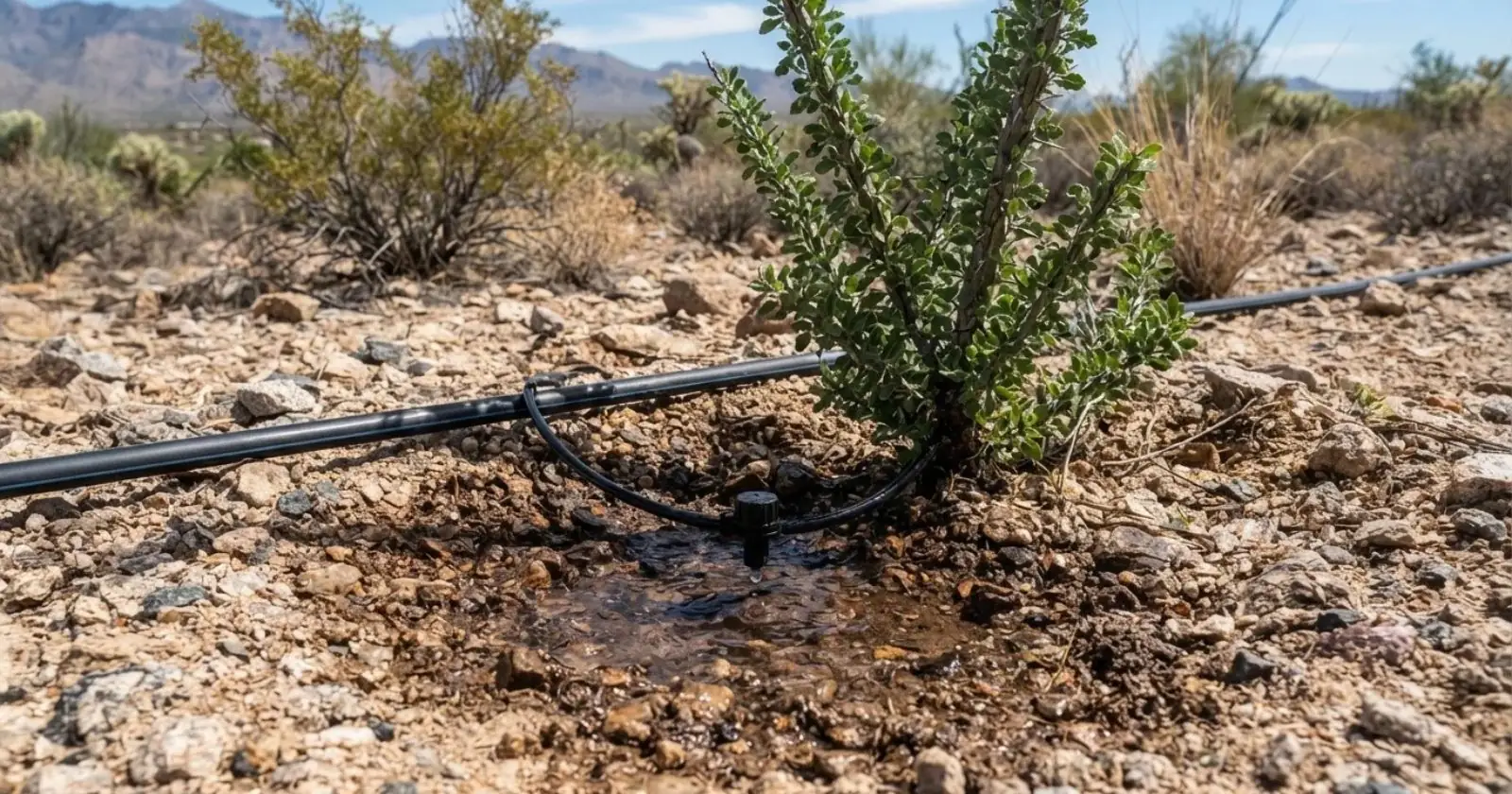
Desert landscaping is the norm across Surprise. Decomposed granite, river rock, and drought-tolerant plants use far less water than a lawn, and they look right in the Sonoran Desert. They also make leaks hard to see. Water that would turn a lawn into a swamp can soak quietly into gravel and disappear.
This guide covers the outdoor leaks we see most, how to find them, and which ones are simple fixes versus ones that need a plumber.
How outdoor water is usually plumbed
Most Surprise homes have three kinds of outdoor water. Hose bibs are the faucets on the outside walls. An irrigation system, usually drip, feeds plants through a network of small tubes and emitters. Some homes also have a line to a pool autofill, a fountain, or patio misters.
The irrigation system usually starts at a set of valves, often in a green plastic box in the yard or mounted near the house. Each valve controls a zone. Many systems also have a backflow device that keeps irrigation water from being drawn back into the drinking supply.
Drip lines and emitters
Drip systems use thin polyethylene tubing and small emitters that release water slowly at each plant. They are efficient, but the parts are small and sit on or just under the surface, where sun, heat, and landscapers' rakes take a toll.
- Emitters pop off the tubing and leave an open hole.
- Tubing cracks where it is exposed to direct sun.
- Fittings separate when the tubing is pulled or stepped on.
- End caps work loose and let water run out the end of a line.
- Rodents and rabbits chew tubing, especially in dry months.
The best way to find these is to run each zone manually and walk it while it runs. Look for water bubbling up, wet patches much larger than an emitter should make, plants that look overwatered while others look dry, and the sound of spraying.
Valve boxes
Open the lid of each valve box and look inside. Standing water in a box that has not run recently means a valve is leaking, either through its body or because it does not close completely. A valve that weeps constantly can waste a surprising amount of water because it never stops.
Sometimes the fix is a new diaphragm or solenoid. Sometimes the valve body has cracked from age and sun. Either way, a leaking valve should be dealt with before the next bill.
Sun damage to exposed pipe
Plastic pipe that is exposed to direct sunlight degrades over time. PVC risers, pipe coming out of the ground to a valve manifold, and the connections at a backflow device all sit in strong sun in a Surprise yard. After years of exposure the plastic becomes brittle and cracks, sometimes when someone simply bumps it.
Painting exposed PVC with a light-colored exterior paint, or adding a cover over the manifold, slows that damage. Pipe that is already chalky or brittle should be replaced before it fails.
Hose bibs
Outdoor faucets work hard here. They feed hoses, misters, and pool top-offs, and they sit in the sun. Common problems include a drip from the spout when the handle is closed, a leak around the handle stem, and a failed vacuum breaker that sprays when the water is on.
The one to watch for is a leak inside the wall behind the faucet. Stains, bubbling paint, or damp stucco around a hose bib mean the pipe feeding it may be leaking into the wall cavity. That needs attention quickly, and our hose bib repair page covers how it is handled.
Backflow protection
The IPC calls for backflow devices on hose connections and on irrigation systems, so that water sitting in a hose or in the soil cannot be siphoned back into your drinking water if pressure drops in the street main.
For a hose bib, that is usually a small vacuum breaker that screws onto the spout. For irrigation, it is often a pressure vacuum breaker, which must sit higher than the highest sprinkler head it protects. Devices that can be tested may need testing on a schedule, covered on our backflow testing page.
A yard leak check you can do in 30 minutes
- Turn off all indoor water and run the meter test to see whether water is escaping.
- Close the house main. If the meter still moves, the leak is outside or on the service line.
- Open each irrigation valve box and look for standing water.
- Run each zone manually and walk it, listening and looking for spraying or pooling.
- Check every hose bib for drips at the spout, handle, and wall.
- Look at exposed PVC for cracks, chalky surfaces, and wet spots.
- Check the backflow device for drips or water running from its vents.
Signs the leak is underground
Sometimes the meter keeps turning after the house shutoff is closed, yet every zone and hose bib checks out. In that case the leak may be on the service line from the meter to the house or on a buried line feeding the irrigation. Clues include a patch of ground that stays damp, plants that suddenly thrive in one spot, or a small depression in the gravel.
Finding a buried leak usually takes listening equipment rather than digging on a guess. The service line itself is covered under water line repair.
Pressure and filters on drip systems
Drip irrigation runs at much lower pressure than household plumbing. Most systems have a pressure regulator and a small filter near the valve so emitters are not blown off the tubing and do not clog with debris. When the regulator fails, emitters start popping off all over the yard. When the filter clogs, some plants get too little water and the tubing can split under backed-up pressure.
If you find several emitters off in the same zone, check the regulator before replacing them one by one. Clean the filter screen at least once a year, more often if your water carries sediment.
Simple fixes you can do
- Push popped emitters back in, or plug the hole with a goof plug.
- Replace a cracked section of drip tubing with a coupler.
- Tighten or replace loose end caps.
- Replace the washer in a dripping hose bib if you are comfortable with it.
- Replace a hose bib vacuum breaker that sprays.
Horse properties add troughs and extra spigots to the list, a common setup for acreage homes in Waddell.
When to call a plumber
- A leak inside the wall behind a hose bib.
- A valve or manifold that is cracked or will not shut off.
- A backflow device that is leaking or failed a test.
- A suspected leak on a buried line.
- Any leak you cannot find after walking every zone.
Outdoor leaks are easy to ignore because they rarely damage anything you can see. They can still add up to a large share of a summer water bill. A half hour walking the yard with the system running catches most of them.
Need a plumber in Surprise?
Outdoor faucet or line leaking? Call to have it repaired with the right backflow protection.
Call (623) 301-9042