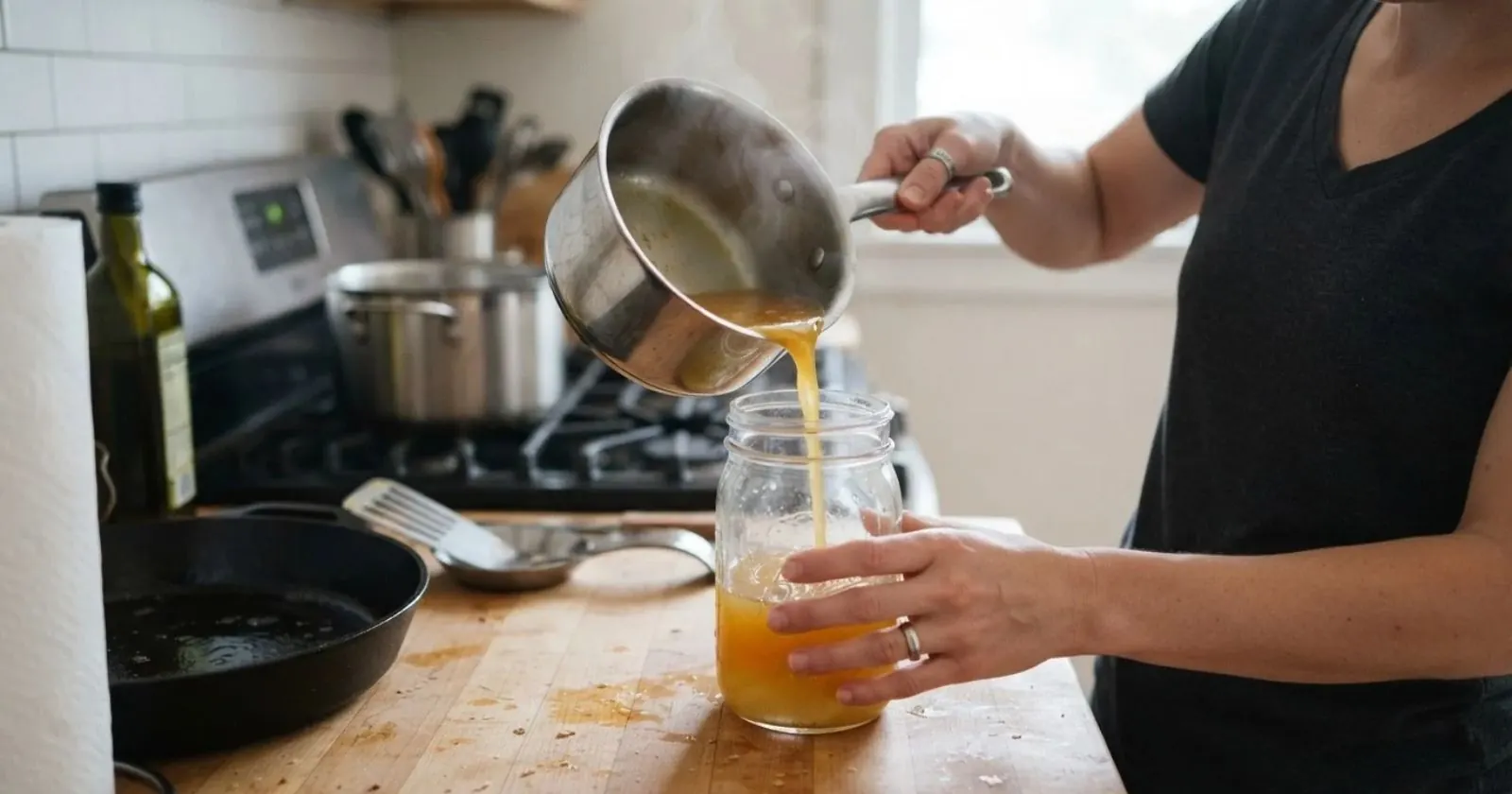
If you ask plumbers what causes most kitchen drain clogs, the answer is almost always the same: grease. Cooking oil, bacon fat, butter, sauces, and dairy all go down the sink as liquids. Then they cool, cling to the pipe walls, and harden. Each time it happens, the pipe gets a little narrower.
The problem is big enough that the City of Surprise runs its own Be G.R.O.S.S. campaign. According to the city, fats, oils, and grease belong in the trash rather than down any drain. Grease does not just clog your own line. It also builds up in city sewer mains, where it can cause backups affecting whole neighborhoods.
Why grease clogs pipes
Hot grease is liquid, so it seems harmless going down the drain. But drain lines are much cooler than a frying pan, and the grease cools as it travels. It sticks to the pipe wall and to anything else passing by, such as food particles and coffee grounds. Over weeks and months, those layers build into a thick coating.
Eventually, the opening is small enough that water drains slowly, then backs up. Because the coating is spread along the pipe rather than stuck in one spot, a quick fix often opens a narrow path without removing the rest.
Myths that make it worse
- Running hot water melts grease away. It moves the grease a little farther down the line before it hardens again.
- Dish soap breaks up grease so it is safe. Soap helps it move, but it still settles and hardens farther down.
- The garbage disposal takes care of it. Disposals grind solids but do nothing to stop grease from coating the pipe.
- A little bit does not matter. Small amounts every day add up faster than large amounts once a month.
- Store-bought drain cleaners fix grease clogs. They may open a small path, but they can damage pipes and leave caustic water behind.
Habits that prevent grease clogs
- Let cooking grease cool and harden, then scrape it into the trash.
- Pour larger amounts of oil into a sealable container and throw it away.
- Wipe greasy pans and plates with a paper towel before washing.
- Use a sink strainer to catch food scraps.
- Keep coffee grounds and eggshells out of the sink, since they bind with grease.
- Scrape plates into the trash rather than using the disposal as a trash can.
Signs of a grease buildup
- The kitchen sink drains slowly, even after plunging.
- Water backs up into one side of a double sink when the other side drains.
- The sink gurgles when the dishwasher runs.
- A bad smell comes from the drain.
- The dishwasher leaves standing water because its drain shares the same line.
How grease clogs are cleared
A drain cable with a cutting head can break through a grease clog and restore flow. That is usually the first step. The catch is that a cable opens a path through the grease rather than removing the coating from the pipe wall, so a heavily coated line may clog again within weeks or months.
When a kitchen line keeps clogging, water jetting scours the grease off the pipe walls and restores close to the full pipe diameter. It is especially useful for homes with a history of repeat clogs and for restaurants, which build grease much faster than households. Our drain cleaning page covers the first step, and hydro jetting covers the deeper clean.
The garbage disposal question
Disposals are convenient, but they are not a way to dispose of grease. They also add food solids to the line, which gives grease more to stick to. If you use a disposal, run plenty of cold water while it runs and for a short time after. Cold water keeps grease solid so it moves through as particles instead of melting and coating the pipe.
Rentals and shared homes
Homes with several occupants, such as rentals or multi-generation households, often see more grease clogs simply because more people are cooking. A short note inside a kitchen cabinet about scraping grease into the trash is an easy reminder. Landlords can also ask for a drain check between tenants, since a partly coated line may not show symptoms until the next household moves in.
Double sinks and dishwashers
Most kitchen sinks, dishwashers, and disposals share one drain line under the counter. When that line narrows, the first symptom is often water rising in one sink bowl while the other drains, or the dishwasher leaving water behind. Those are early warnings. Dealing with them then is far easier than waiting for a full backup.
Businesses and grease
Restaurants and food service businesses produce far more grease than homes. The City of Surprise has a commercial pretreatment program and fats, oils, and grease requirements that often call for a grease interceptor or trap maintained on a schedule. A neglected trap sends grease into the business's own line first, and then into the city's.
Why grease is a neighborhood problem
Grease that makes it past your own lateral does not disappear. It enters the city's sewer mains, where it combines with grease from other homes and businesses. Over time those deposits can narrow a main enough to cause a backup, and when a main backs up, sewage can come up in several homes at once, usually through the lowest drains.
That is why the city treats fats, oils, and grease as a community issue rather than a private one. Keeping grease out of your sink protects your neighbors as much as it protects you.
When grease piles up fastest
Holidays and big gatherings are hard on kitchen drains. Roasting, frying, and cooking for a crowd produce far more fat than a normal week, and it often ends up in the sink during cleanup. Keep a container by the stove for grease during those meals, and wipe roasting pans before they go in the sink.
Frying at home is another common source. A pan of used frying oil poured down the drain can do more damage than months of normal cooking.
Do enzyme products help?
Enzyme and bacteria-based drain products are sold as maintenance treatments. They can help keep a clear line clear in some cases, but they are slow and will not open a line that is already clogged. They are not a substitute for keeping grease out of the drain in the first place.
What to do if your kitchen sink backs up
- Stop running water and do not start the dishwasher.
- Try a plunger, covering the other side of a double sink.
- Avoid chemical drain openers, especially if you will need a plumber afterward.
- If other drains in the house are also slow, the problem may be the main line.
- Call if the sink will not drain, or if it backs up again within a short time.
Older sewer laterals are less forgiving of grease, which is why kitchen backups are a frequent call in original Youngtown homes.
The takeaway
Grease causes more kitchen clogs than anything else, and hot water, soap, and disposals do not make it safe to pour down the drain. Cooling it and throwing it in the trash is the simplest habit that prevents most kitchen backups. It also protects the city's sewer lines that everyone shares.
Need a plumber in Surprise?
Kitchen sink backing up? Call any hour to have the line cleared and tested.
Call (623) 301-9042