Surprise grew from about 30,000 residents in 2000 to more than 117,000 in 2010, according to the U.S. Census. Many of the homes built in that decade were plumbed with PEX, a flexible plastic tubing made from cross-linked polyethylene. It went into homes quickly, resisted scale better than copper, and did not suffer the pinhole corrosion that some copper systems develop.
PEX itself holds up well. When a PEX system leaks, the cause is usually not the tubing in the middle of a run. It is a fitting, an installation shortcut, or something about where the line was placed. Knowing those weak spots helps you catch problems early.
What PEX is and how it is connected
PEX tubing comes in rolls and bends around corners, so it needs fewer fittings than rigid pipe. Where it does connect, it uses one of a few methods: metal crimp or clamp rings squeezed over a fitting, expansion fittings where the tubing is stretched over the fitting and shrinks back, or push-to-connect fittings. Each method is reliable when done correctly.
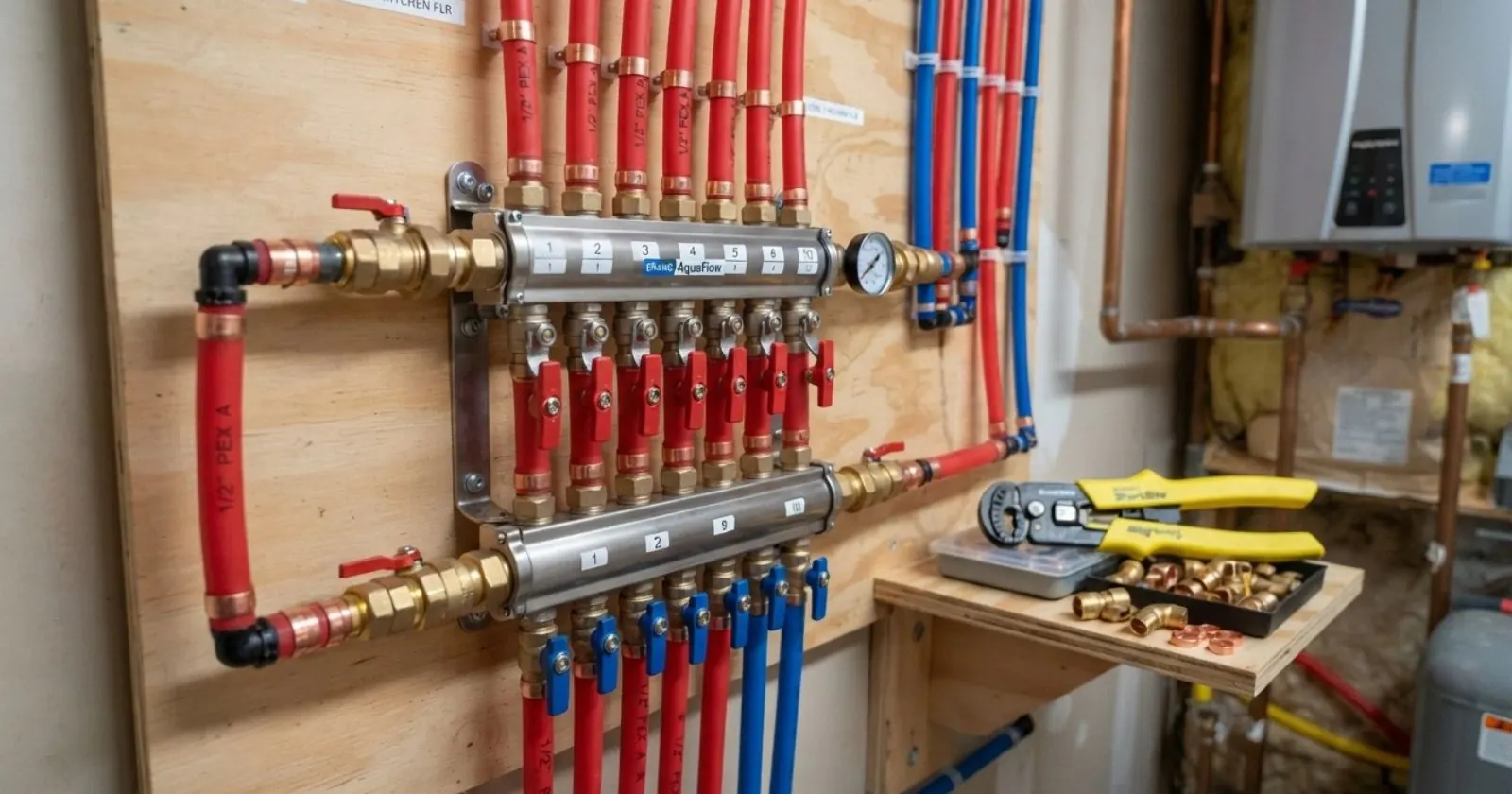
Many systems from this era use a manifold, a central distribution block with individual lines running to each fixture. That design means fewer hidden joints in walls, and it gives you a handy set of shutoffs in one place.
Failure point 1: fittings
Most PEX leaks start at a fitting. A crimp ring that was not fully compressed, a fitting that was slightly misaligned, or a ring placed too close to the end of the tubing can hold for years and then weep. Some brass fittings used in the 2000s were also prone to a type of corrosion called dezincification in certain water conditions, which can narrow the fitting or cause it to fail.
Signs to watch for include white or green crust on a brass fitting, a small drip at a connection under a sink, or staining on a ceiling below an attic run.
Failure point 2: sunlight
PEX degrades when exposed to ultraviolet light. It is meant to be hidden inside walls, ceilings, and attics. Sections left exposed outside, such as a run to a hose bib, a water heater connection in a sunny garage window, or tubing left uncovered in a yard, can become brittle over time.
Any exposed PEX outdoors should be sleeved, covered, or replaced with a UV-resistant material.
Failure point 3: attic heat
Many Surprise homes from this period run supply lines through the attic, where summer temperatures climb far above what the living space sees. PEX handles heat within its rated range, but heat is hard on fittings, especially where tubing is pulled tight or kinked at a connection. Movement from repeated heating and cooling can loosen a marginal joint.
A ceiling stain that shows up after a hot stretch, often far from the fixture it feeds, is a classic sign of an attic leak.
Failure point 4: chemicals and rodents
PEX has a rating for chlorine resistance, and water that is hot and chlorinated places the most demand on it. That is one reason hot water lines are worth watching more closely than cold ones. Separately, rodents occasionally chew PEX in attics and crawl spaces. It is not common, but a single chewed line can cause a lot of damage.
Failure point 5: installation shortcuts
- Tubing pulled tight with no slack to allow for expansion.
- Lines resting directly on sharp framing or metal edges without protection.
- Kinks at tight bends that were straightened rather than cut out.
- Missing support straps, so long runs sag and pull on fittings.
- Tubing too close to a heat source such as a water heater flue.
None of these show up on day one. They show up years later as a slow leak at a fitting or a split at a stress point.
What to check in your own home
- Look under every sink and behind every toilet for crust or dampness at fittings.
- Check the water heater connections for staining or drips.
- Find the manifold, if you have one, and look for weeping at any port.
- Look at the ceiling for stains, especially in rooms below attic runs.
- Walk the outside of the house for any exposed PEX.
- Put a pressure gauge on a hose bib and read it. The IPC caps static pressure at 80 psi, and high pressure adds stress to every fitting.
Repair or repipe?
A single leaking fitting is a simple repair. The failed fitting is cut out and replaced, often in minutes once it is exposed. That is the normal outcome for PEX problems in homes from this era.
A different picture emerges when several fittings of the same type fail, or when a home has a known problem fitting throughout. At that point, replacing the fittings or the affected runs may make more sense than waiting for each one to leak. For hidden leaks, leak detection finds the source first, and our repiping page covers when a larger replacement is worth it.
PEX is not polybutylene
Homeowners sometimes confuse PEX with polybutylene, a gray plastic pipe that went into many homes from the late 1970s to the mid-1990s that became known for failing. They are different materials. Polybutylene is usually gray and was used largely before most of Surprise was built. PEX is often red, blue, or white, and it is printed along its length with the letters PEX and its rating.
If you are not sure what your home has, look at the lines coming out of the wall under a sink or at the water heater. The printing on the tubing usually tells you.
What to tell a plumber when you call
Describe where the water appeared, when you first noticed it, and whether it follows hot weather or heavy hot water use. Mention whether your home has a manifold and whether the lines run through the attic or under the slab if you know. Those details point straight to the likely fitting and save time on the visit.
Why PEX is still a good material
None of this means PEX is a bad choice. It resists scale, handles expansion better than rigid pipe, is quicker to install, and is still one of the most common materials used in repipes today. The issues above are about fittings, installation, and placement, not the tubing itself. A well-installed PEX system with good fittings can last for decades.
Manifold shutoffs are your friend
If your home has a PEX manifold, find it and learn how the valves are labeled. Each valve usually controls one fixture or one room. When a line leaks, closing just that valve lets the rest of the house keep water while you wait for a repair. It is one of the most useful features of these systems, and many owners do not know it is there.
Tract homes built in the same decade across the river in El Mirage often have similar PEX systems and fittings.
The takeaway
If your Surprise home was built in the 2000s, it very likely has PEX. Most of the time, it will be trouble-free. When something goes wrong, look first at fittings, attic runs, and any exposed sections. Catching a weeping fitting early turns a potential ceiling repair into a simple fix.
Need a plumber in Surprise?
Leak at a PEX fitting or a ceiling stain under the attic? Call to have it found and fixed.
Call (623) 301-9042