Pools are part of life in the West Valley, and so is water loss. Hot air, low humidity, strong sun, and afternoon wind all pull water out of an open pool. An autofill makes that easy to ignore because it quietly tops the pool back up. The trouble is that it tops up a leak just as quietly.
If your water bill has crept up in summer, or your autofill seems to run constantly, the first question is whether you are dealing with normal evaporation or something more.
What drives evaporation
- Air temperature. Hotter air pulls more water.
- Humidity. Dry air, typical of Surprise outside the monsoon, speeds evaporation.
- Wind. Moving air across the surface carries moisture away.
- Sun exposure. A pool in full sun loses more than one shaded by walls or trees.
- Water features. Waterfalls, fountains, and spillways increase the surface area exposed to air.
- Water temperature. A heated pool evaporates faster than an unheated one.
Because every pool is different, there is no single evaporation number that applies to all of them. The only reliable comparison is your own pool against water in the same conditions, which is what the bucket test does.
How to run the bucket test
- Turn off the autofill. If you skip this step, the test will not work.
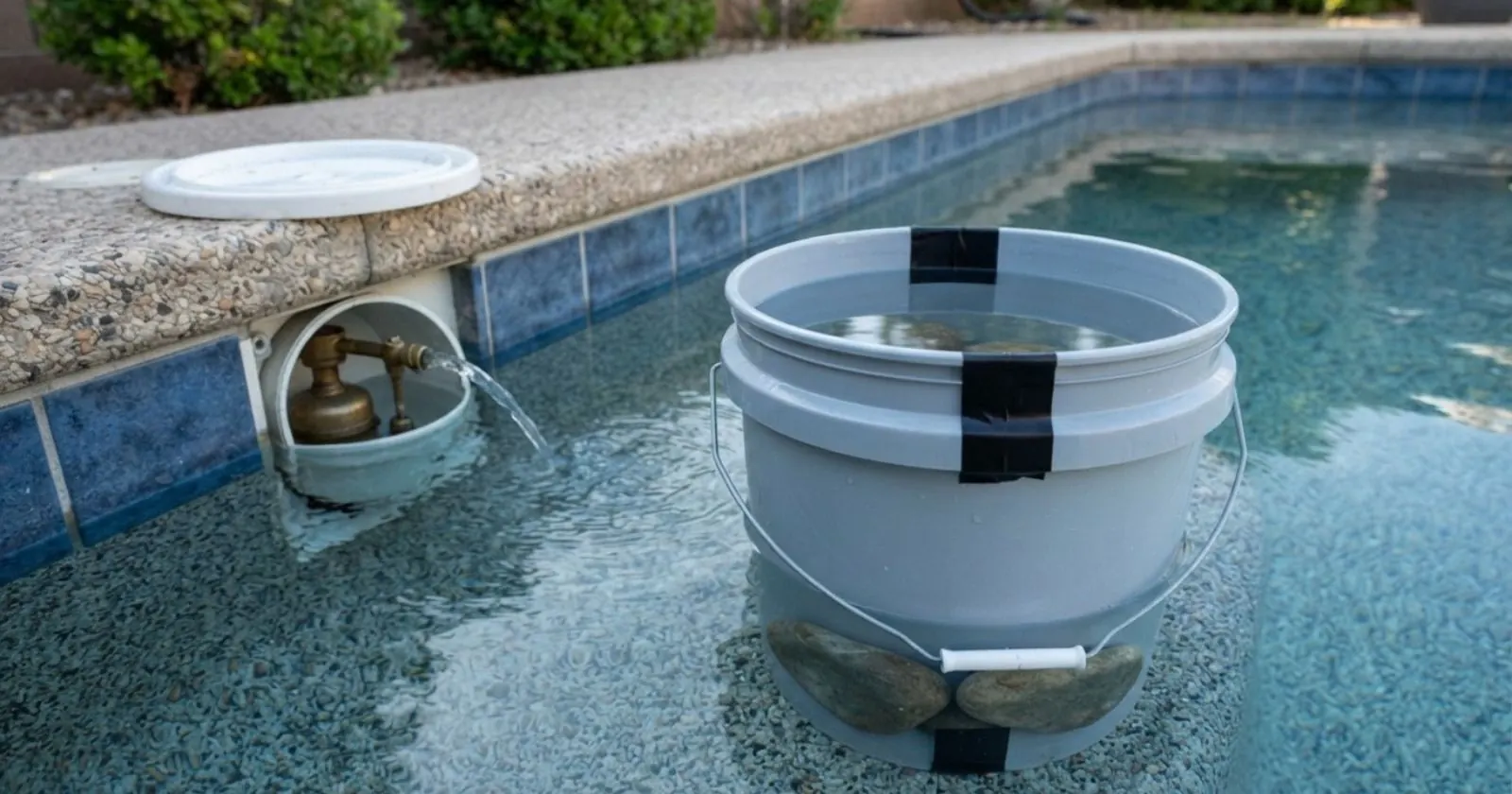
- Fill a bucket with pool water to about an inch from the top.
- Set the bucket on the first or second pool step so it sits in the pool water and sees the same sun and temperature.
- Mark the water level inside the bucket.
- Mark the pool water level on the outside of the bucket.
- Run the pump on its normal schedule and do not add water or swim.
- After 24 hours, compare the drop inside the bucket with the drop in the pool.
If both dropped about the same, you are seeing evaporation. If the pool fell clearly further than the bucket, water is escaping some other way.
For a clearer answer, run the test twice: once with the pump running on its normal schedule and once with the pump off. If the pool loses more with the pump on, the leak is often on the pressure side of the plumbing. If it loses more with the pump off, it is often on the suction side.
Where pool leaks usually hide
Many people assume a leak means a crack in the pool shell. More often, the water is escaping from the plumbing and equipment.
| Location | Clue | What is usually involved |
|---|---|---|
| Equipment pad | Wet spots near the pump, filter, heater, or valves. | Worn seals, unions, or fittings. |
| Underground return and suction lines. | Pool loses more with the pump running or off. | A cracked or separated line. |
| Skimmer | Loss stops at the skimmer opening. | A crack where the skimmer meets the shell. |
| Pool light | Loss stops at the light level. | A worn seal or conduit in the light niche. |
| Autofill line | Water bill up but pool stays full. | A leaking autofill valve or supply line. |
The level test
If you suspect a leak, turn off the autofill and let the pool drop for several days, marking the level each day. Often the water stops falling at a specific point, such as the bottom of the skimmer opening or the middle of the light. Where it stops is a strong hint about where the leak is.
Why the autofill is a blind spot
An autofill is a direct connection between your drinking water and the pool, which is why the IPC calls for a backflow device on that connection. It is also the perfect disguise for a leak. Because the level never drops, the water bill may be the only clue.
The autofill line can leak too. It usually runs underground from the house supply to the pool, and a crack can send water into the soil without the pool level ever changing. If your meter keeps moving with the house quiet and the pool autofill off, the leak may be on that line.
Signs it is time to call
- The pool drops more than the bucket in a bucket test.
- The autofill seems to run constantly.
- Soggy ground or sinkholes near the pool deck or equipment.
- Cracks in the deck or tiles that are new.
- Algae that keeps returning despite normal chemical levels, a sign of constant fresh water.
Most leaks in the plumbing lines and equipment can be found by pressure testing each line and listening for escaping water. Our pool leak detection and repair page explains the process. If the loss turns out to be on the house side, whole-property leak detection checks the rest of the system.
What the equipment pad should look like
Walk out to your pool equipment with the pump running. The pad should be dry apart from normal splashes. Look for drips at the pump lid, unions, valves, and the filter. Check for white crust around fittings, which shows where water has been escaping and evaporating.
Listen too. A pump that sounds like it is pulling air, or a basket that never fills completely, can point to a leak on the suction side, where air gets in instead of water getting out. Those leaks do not always show up as water on the ground.
Autofill upkeep
The autofill valve works like a toilet fill valve, and it wears out in similar ways. Scale and debris can keep it from closing fully, so it trickles water into the pool constantly. If the pool overflows its skimmer or the level sits higher than the setting, the valve may be sticking.
Most autofill valves can be cleaned or rebuilt. If yours has been in service for many years, replacing it is inexpensive compared with a summer of wasted water.
Reducing evaporation
If the bucket test shows normal evaporation, you can still cut the loss. A pool cover is the most effective step when the pool is not in use. Running waterfalls and fountains less often helps, and so does lowering the heater setting in warmer months. Windbreaks such as fences or plantings reduce the air moving across the surface.
Keep a simple log
Write down the pool level each morning for a week in summer with the autofill off, along with the temperature and whether the pump ran. A log like that makes patterns obvious. A steady loss that tracks with heat is evaporation. A loss that stays high on cool, calm days, or that changes when the pump runs, points to a leak.
It also gives a technician a head start. Knowing how much the pool drops per day, and under what conditions, narrows the search before any pressure testing begins.
Newer subdivisions with backyard pools in El Mirage run into the same autofill blind spot.
The takeaway
Before assuming a leak, run the bucket test with the autofill off. It costs nothing and gives a clear answer. If the pool does lose more than the bucket, look first at the equipment and plumbing lines, since that is where most pool leaks are found.
Need a plumber in Surprise?
Pool dropping faster than the bucket? Call to have the leak located and repaired.
Call (623) 301-9042