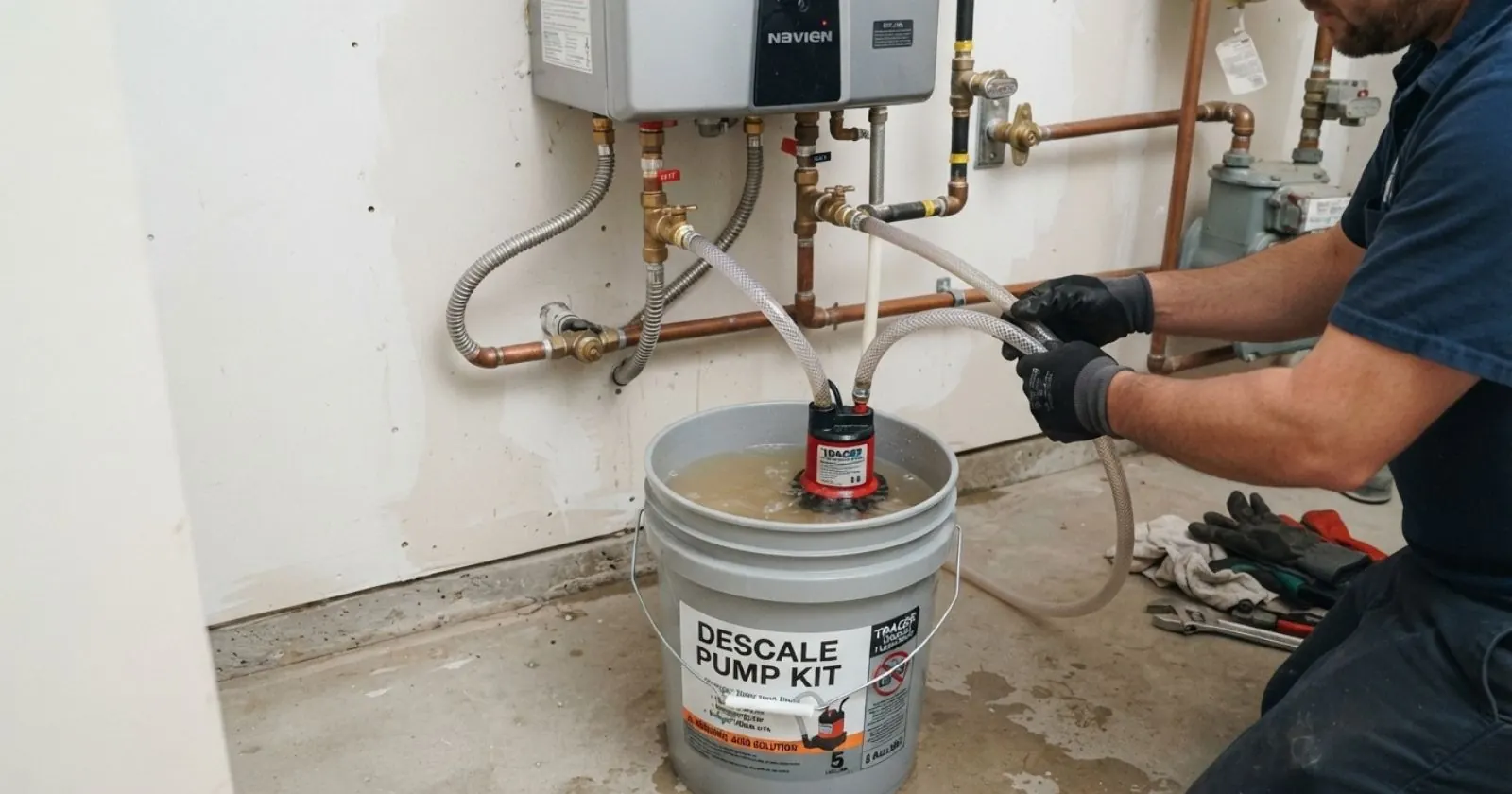
A tankless water heater is a smart choice for many homes. It heats water only when you need it, frees up floor space, and never runs out halfway through a shower. But it has one weakness that matters a lot in the West Valley: the narrow passages of its heat exchanger collect mineral scale far faster than the open bottom of a tank.
This guide explains why that happens, how often to descale based on your water, what a proper flush involves, and how to tell when your unit is overdue.
Why scale hits tankless units hardest
In a tank heater, minerals settle to the bottom as sediment. In a tankless unit, water races through a small heat exchanger that gets very hot for short bursts. Calcium and magnesium come out of solution on those hot surfaces and stick. Over time the layer grows, narrowing the passages and insulating the metal from the water.
When that happens, the burner has to work harder to reach the set temperature, the heat exchanger runs hotter than it should, and safety sensors start tripping. The unit may still produce hot water, but with lower flow, temperature swings, or intermittent shutdowns.
How often to descale
Manufacturer guidelines set a maintenance interval in each unit's manual, and that should be your first reference. As a practical rule, the harder your water, the shorter the interval. Water in Surprise and nearby towns varies between moderately hard and hard, depending on which system serves you, so testing your tap is the best way to set a schedule.
| Your tap hardness | Suggested starting interval | Notes |
|---|---|---|
| Under 3.5 gpg or softened. | Every 1 to 2 years. | Softened water slows scale dramatically. |
| 3.5 to 7 gpg | About once a year | Watch flow and error history. |
| 7 to 10.5 gpg | Every 6 to 12 months. | Heavier use calls for the shorter end. |
| Over 10.5 gpg | Every 6 months or sooner. | Strong case for adding a softener. |
Always follow your unit's manual first. Some warranties require descaling at set intervals in hard water, so keep a record of every service.
What you need
- Isolation valves on the hot and cold lines at the heater, sometimes sold as a service valve kit.
- A small submersible pump and a five-gallon bucket.
- Two washing machine style hoses to connect the pump and the drain port.
- About four gallons of undiluted white vinegar or a descaling solution approved by the manufacturer.
- A towel and a screwdriver for the inlet filter screen.
If your unit does not have isolation valves with drain ports, adding them is the single most useful upgrade you can make. Without them, descaling means cutting or disconnecting lines each time, which is a job for a plumber.
Step-by-step descaling
- Turn off power to the unit, and on gas models shut the gas supply valve.
- Close the hot and cold isolation valves so the heater is cut off from the house.
- Attach one hose from the pump outlet to the cold-side service port and a second hose from the hot-side port back into the bucket.
- Pour the vinegar or descaler into the bucket and submerge the pump.
- Open both service ports and run the pump so the solution circulates through the heat exchanger.
- Let it circulate for the time given in the manual, often around 45 to 60 minutes.
- Turn off the pump, close the service ports, and dispose of the used solution.
- Remove and rinse the cold-water inlet filter screen, then reinstall it.
- Open the isolation valves, flush clean water through, restore gas and power, and test a hot tap.
The used solution often comes out cloudy or gritty. That is the scale you just removed. If it comes out heavily discolored after a short run, the unit was overdue, and it may be worth circulating a fresh batch.
When to call: signs your unit is overdue
- Hot water flow is noticeably lower than when the unit was new.
- Water temperature surges and drops during a single shower.
- The display shows overheating or flow-related error codes.
- The unit shuts off mid-use and restarts.
- You cannot remember the last time it was descaled.
One of these alone may have another cause, such as a clogged inlet screen or a failing flow sensor. Several together almost always point to scale. If descaling does not clear the problem, a tankless service visit can read the error history and test the sensors.
Should you add a softener?
If your tap reads in the hard or very hard range, a softener changes the math on tankless ownership. It cuts scale at the source, which stretches the descaling interval, reduces error codes, and helps the heat exchanger last. It also protects faucets, toilets, and glass shower doors.
A softener is not required to own a tankless heater, but in hard water it is the most effective way to protect one. Start with a tap test and size from that reading, as described on our water softener page.
Do-it-yourself or professional service?
If your unit has isolation valves and you are comfortable with the steps above, descaling is a reasonable homeowner task. A professional visit makes more sense when the unit has no service valves or shows persistent error codes. It also helps for a gas model whose venting and combustion have not been checked in a while, or a unit still under warranty that needs a service record.
Common descaling mistakes
- Diluting the vinegar. Use it full strength, or the descaler exactly as the manufacturer directs.
- Running the pump for only a few minutes. The solution needs time to dissolve deposits.
- Forgetting the inlet screen. A clogged screen can cause the same low-flow symptoms as scale.
- Leaving gas or power on during the flush.
- Pouring used solution onto landscaping instead of down a drain.
- Skipping the clean-water rinse, which can leave an acidic taste at the tap for a while.
Gas and electric units age differently
Gas tankless units have a burner, a fan, and a vent to maintain along with the heat exchanger. Their error codes often point to ignition, flame, or venting problems as well as scale. A yearly look at the vent for gaps, damage, or nesting birds is worth adding to the routine.
Electric tankless units have no flame or vent, but they draw a lot of current through heating elements that scale can damage. When an element fails on an electric unit, the heater may still run but deliver lower temperatures at higher flow. Descaling protects the elements in the same way it protects a gas heat exchanger.
The same descaling schedule applies just east of the city, where El Mirage tankless owners see similar scale on groundwater supplies.
A simple yearly routine
- Test your tap hardness once a year.
- Descale on the interval that matches the reading.
- Clean the inlet screen at every descale.
- Check the display for stored error codes.
- On gas units, look at the vent for damage or blockage.
- Write the date in a notebook or on a tag at the heater.
A tankless heater that is descaled on schedule can run efficiently for many years. One that is ignored in hard water can lose much of its output long before its time. The difference is usually one afternoon a year.
Need a plumber in Surprise?
Tankless unit throwing codes or losing flow? Call to book a descale and service visit.
Call (623) 301-9042