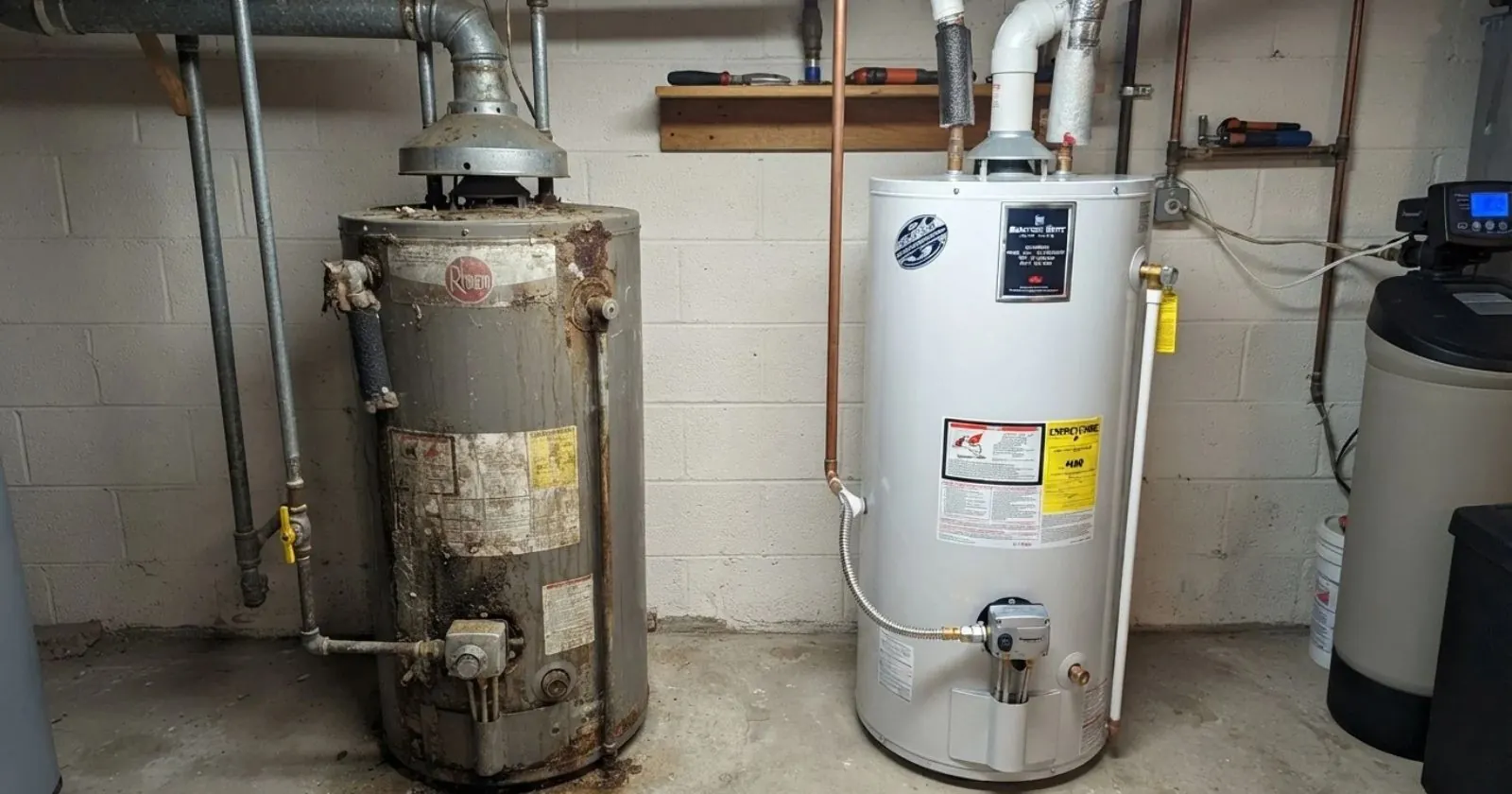
Few household problems feel as urgent as a water heater that stops working. Cold showers, a puddle in the garage, or a tank that pops and rumbles all demand a decision, and often quickly. Should you fix what you have or put in a new one?
There is no single answer for every home, but the decision usually comes down to a handful of factors. Knowing them lets you make the call with confidence rather than under pressure.
Factor 1: age
Most tank heaters give roughly 8 to 12 years of service. In Surprise, where water is often hard and heaters sit in hot garages, many land toward the shorter end. Age is the single biggest factor in the decision.
To find the age, read the serial number on the data label. Most brands encode the manufacture date in the first few characters. A quick search for your brand and the words serial number date code will show you how to read it.
Factor 2: where it is leaking
A leak from a fitting, the drain valve, or the relief valve is a repairable problem. Those are separate parts that can be replaced.
A leak from the tank body itself, usually seen as water under the heater with no obvious source, or rust streaks from the bottom seam, means the tank has corroded through. That cannot be repaired. The only fix is replacement.
Factor 3: what failed
| Problem | Usually | Why |
|---|---|---|
| Pilot will not stay lit. | Repair | Often a thermocouple or thermopile. |
| No heat on a gas unit. | Repair | Gas control valve or igniter. |
| Lukewarm water on an electric unit. | Repair | One element or thermostat has failed. |
| Relief valve dripping | Repair or add expansion tank. | Pressure or a worn valve. |
| Rotten egg smell | Repair | Anode rod reaction |
| Leak from the tank body. | Replace | The tank has corroded through. |
| Heavy rumbling and slow heating. | Depends on age | Sediment has built up |
Factor 4: the 50 percent rule
A common rule of thumb says that if a repair costs half or more of what a new heater would, replacement is usually the better value. That is especially true on an older tank, where another part is likely to fail soon after the first.
The rule is a guide, not a law. A new part on a five-year-old heater is almost always worth it even if the part is expensive, because the tank has years left. The same repair on a 12-year-old heater is harder to justify.
Factor 5: warranty
Many tank water heaters carry a tank warranty and a separate parts warranty, often of different lengths. If your heater is still within its tank warranty and the tank fails, the manufacturer may cover the tank itself, though labor is often not included. Check the data label and your paperwork before deciding.
What drives the cost of a repair
- The part. A thermocouple costs far less than a gas control valve.
- Gas, electric, or tankless. Tankless diagnosis and parts often cost more.
- Time of the call. Night and holiday service costs more than a scheduled visit.
- Condition of the tank. A heavily scaled tank may need a flush before a repair holds.
- Code items found on site, such as a missing expansion tank or a relief line routed badly.
What drives the cost of a replacement
- Type and size. A standard 40 or 50 gallon tank costs less than a heat pump or tankless unit.
- Fuel. Staying with the same fuel is simplest. Switching from electric to gas, or the reverse, adds work.
- Code upgrades. Raising a gas unit off the floor, adding an expansion tank, or correcting venting adds parts and labor.
- Permits. Many water heater replacements need a city permit and inspection.
- Location and access. A tight closet or attic location costs more than an open garage corner.
When a repair makes sense
Repair is usually the right choice when the heater is under about eight years old, the tank is not leaking, and the failed part is a common one such as a thermocouple, element, or thermostat. In that case, a water heater repair restores hot water and the heater still has years of life ahead.
When replacement makes sense
Replacement is usually the better value when the tank is leaking, the heater is past 10 years old, the repair would cost half or more of a new unit, or the heater has needed several repairs recently. It is also a good time to reconsider the type and size of heater you want. Our water heater replacement page compares gas, electric, heat pump, and tankless options.
Planned replacement versus emergency replacement
Replacing a water heater before it fails has real advantages. You can compare options, choose the right size, schedule the work, and handle any permit without a cold house or a flooded garage. An emergency replacement is usually limited to whatever unit is available that day, and it can come with after-hours pricing.
If your heater is past 10 years and showing early signs such as rumbling, rust-tinged hot water, or a relief valve that drips, planning a replacement is often cheaper in the end than waiting for it to fail.
Questions to ask on any quote
- Does the price include removing and disposing of the old heater?
- Is a permit required, and is it included?
- Will the install include an expansion tank if one is needed?
- Will a gas unit be raised off the floor to meet code?
- What warranty comes with the new heater, and what does it cover?
- Are new supply connectors and a new relief valve discharge line included?
What to do: a quick way to decide
- Is the tank body leaking? If yes, replace.
- Is the heater past 10 years old? If yes, lean toward replacing.
- Is the repair more than half the cost of a new heater? If yes, lean toward replacing.
- Has it needed repairs in the past year? If yes, lean toward replacing.
- If none of these apply, repair.
Choosing the type of replacement
Replacement is also a chance to reconsider the type of heater. A standard tank is the simplest like-for-like swap. A heat pump water heater uses far less electricity and works well in a warm Surprise garage. A tankless unit saves space and never runs out of hot water but needs regular descaling in hard water. The right choice depends on your fuel, your space, and how much upkeep you are willing to do.
In the 1950s homes of Youngtown, a replacement is also a chance to check the older shutoff valves and supply lines around the heater.
Protecting whichever you choose
Hard water shortens water heater life here. Draining a few gallons through the bottom valve a couple of times a year slows sediment buildup, and a softener sized from a tap test cuts scale at its source. Checking the relief valve and anode rod every few years catches problems early.
A repaired heater with good maintenance can reach the long end of its life. A new heater installed with the right safety parts and protected from scale can do even better.
Need a plumber in Surprise?
Not sure whether to repair or replace? Call for a diagnosis and a price on both.
Call (623) 301-9042