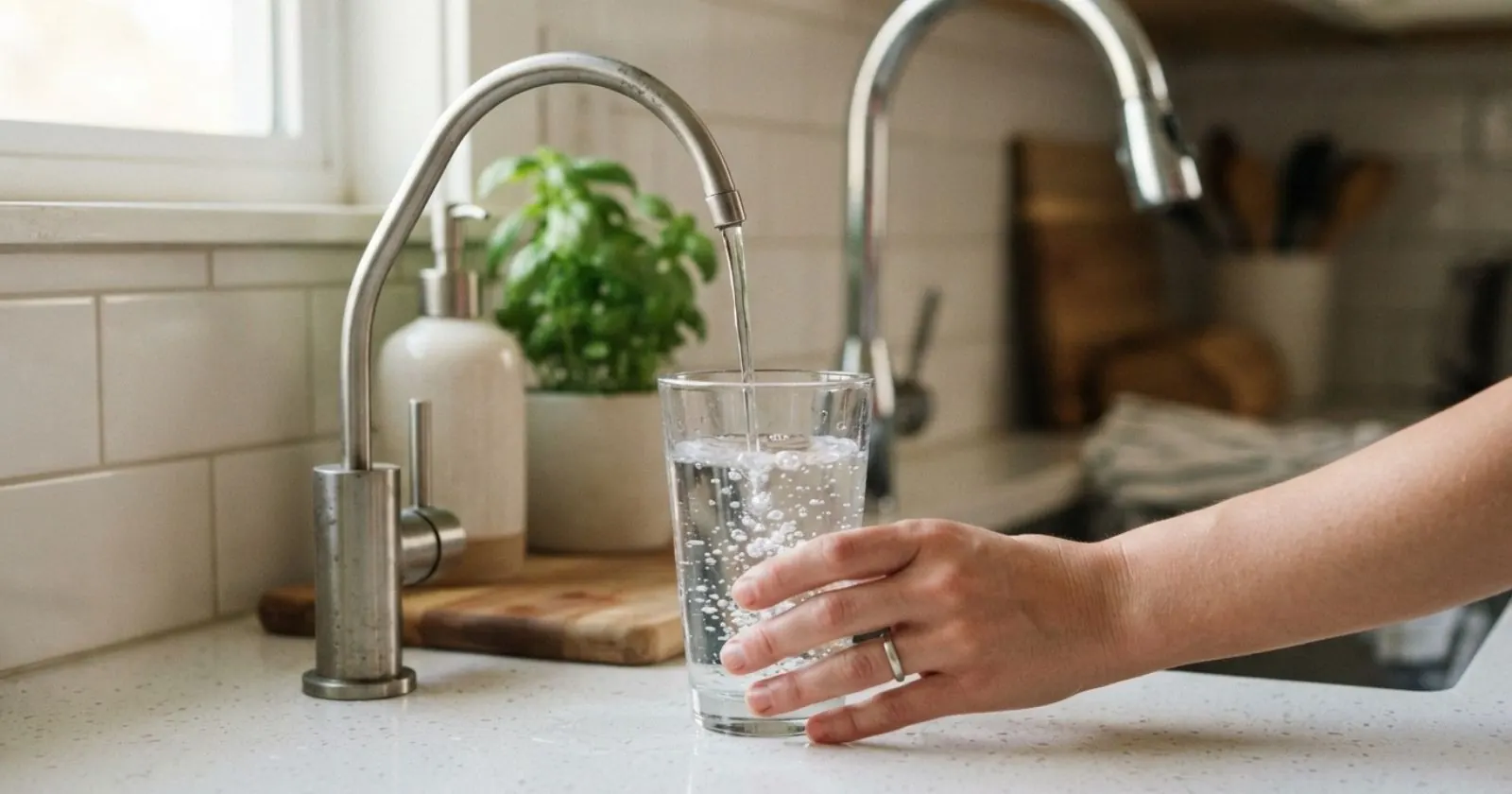
If you are thinking about filtering your water in Surprise, you will quickly run into two main options. Reverse osmosis, usually installed under the kitchen sink, produces drinking and cooking water. Whole-home filtration, installed where the water enters the house, treats every tap. They are often compared as if they compete, but they do different jobs.
This guide explains how each works, what the certifications on the box mean, and how to decide which one, or both, makes sense for your home.
Start with your water report
Water in Surprise comes from more than one system, including EPCOR's Agua Fria district and systems run by the City of Surprise. Each publishes an annual water quality report listing what was measured in the water. That report is your starting point. It tells you what is present and at what level, which helps you decide whether a filter is worth it and what kind.
Utility water must meet federal drinking water standards. Many people filter anyway because they want better taste, less chlorine smell, or lower total dissolved solids. Those are reasonable goals, and knowing which one matters most to you guides the choice.
How reverse osmosis works
Reverse osmosis forces water through an extremely fine membrane that lets water molecules through while holding back a large share of dissolved solids. Most systems also include sediment and carbon pre-filters to protect the membrane and remove chlorine, plus a carbon post-filter for taste.
The treated water goes into a small storage tank and comes out of a separate faucet at the kitchen sink. The rejected water, carrying the concentrated solids, goes down the drain. Newer systems send less water to the drain than older ones, but every RO system uses some.
How whole-home filtration works
A whole-home system treats all the water entering the house. The most common type uses carbon to reduce chlorine taste and odor, often with a sediment pre-filter to catch particles. Every tap, shower, and appliance gets the treated water.
Whole-home carbon systems do not remove dissolved minerals, so they do not soften water or lower total dissolved solids much. They are about taste, smell, and some contaminants, depending on the media.
| Question | Reverse osmosis | Whole-home carbon |
|---|---|---|
| What it treats | One faucet, usually kitchen | Every tap in the house. |
| Main benefit | Lower dissolved solids for drinking. | Less chlorine taste and odor everywhere. |
| Removes hardness | Largely, at that one faucet. | No |
| Water to drain | Yes, some | No |
| Upkeep | Pre-filters and membrane on a schedule. | Media or cartridge replacement |
What the certifications mean
Any filter worth buying should carry NSF/ANSI certification, which means the product was independently tested to confirm what it claims to reduce. Three standards matter most for home systems.
- NSF/ANSI 42 covers aesthetic effects such as chlorine taste and odor.
- NSF/ANSI 53 covers health-related contaminants, and each certified product lists which ones.
- NSF/ANSI 58 covers reverse osmosis systems specifically.
Certification is specific. A product certified under Standard 42 for chlorine taste has not necessarily been tested for anything else. Read the list of reduced contaminants, not just the logo.
Chlorine or chloramine?
Utilities disinfect water with either chlorine or chloramine, a combination of chlorine and ammonia that lasts longer in the pipes. Standard carbon handles chlorine well, but chloramine needs a catalytic carbon media to be reduced effectively. Your water report or a call to your supplier will tell you which one is used, and that matters when choosing a whole-home system.
Where a softener fits in
Neither RO nor whole-home carbon is a replacement for a water softener if hard water is your problem. A softener removes the calcium and magnesium that cause scale on fixtures, in water heaters, and in tankless units. Many Surprise homes end up with a softener for the whole house and an RO system at the kitchen sink for drinking water. Our water softener page explains how to size one from a tap test.
What to do before you buy: how to choose
- Read your supplier's water quality report.
- Decide what you want to change: taste, smell, dissolved solids, or scale.
- If it is drinking water taste and dissolved solids, look at RO.
- If it is chlorine smell in showers and throughout the house, look at whole-home carbon.
- If it is scale, look at a softener.
- Check NSF/ANSI certifications against what you want to reduce.
- Plan for filter changes and their ongoing cost.
Why RO water can taste flat
Because reverse osmosis removes much of the dissolved mineral content, some people find the water tastes flat compared with tap water. Many systems offer a remineralization stage that adds a small amount of calcium and magnesium back for taste. If you are sensitive to taste, ask whether the system you are considering has that option.
Upkeep and ongoing cost
Every filtration system has ongoing costs. RO pre-filters usually need changing more often than the membrane, and the membrane itself lasts longer when the pre-filters are kept fresh. Whole-home carbon systems need their media or cartridges replaced on a schedule based on water use.
Skipping filter changes does more than reduce performance. An overloaded carbon filter stops doing its job, and a neglected RO membrane can foul and slow to a trickle. Mark change dates on the housing or set a reminder.
When comparing systems, ask about the cost of replacement filters as well as the price of the unit. A cheaper system with expensive or hard-to-find cartridges can cost more over several years.
Installation considerations
An RO system needs space under the sink for the tank and filters, a drain connection, and usually a hole in the countertop or sink for its faucet. Whole-home systems need space where the main line enters, often in the garage, and a bypass so the system can be serviced without cutting water to the house.
Homes on private wells in rural areas need a different approach, usually starting with a lab test and sediment filtration. Our water filtration installation page covers both utility and well water setups.
Refrigerators and ice makers
An RO system can also feed a refrigerator's water dispenser and ice maker through a small line run from the storage tank. If you plan to do that, mention it before installation, since the line length and pressure affect how well the dispenser works. Many refrigerators already have their own filter, which becomes redundant once RO water feeds them.
Pitcher and faucet-mount filters
Not every home needs a plumbed-in system. Pitcher filters and faucet-mount filters are inexpensive ways to improve taste, and many carry NSF/ANSI 42 certification for chlorine. They treat small amounts of water and need frequent cartridge changes, but they are a sensible way to test whether filtered water makes enough difference to justify a larger system.
If you find yourself refilling a pitcher all day, that is a good sign an under-sink RO system or a whole-home filter would suit you better.
Homes on private wells need a lab test before any of these choices, which is typical for properties around Wittmann.
The takeaway
Reverse osmosis gives you excellent drinking water at one faucet. Whole-home carbon improves taste and smell everywhere. A softener deals with hardness. Starting with your water report and a clear idea of what you want to change leads you to the right combination, rather than the most expensive one.
Need a plumber in Surprise?
Want help picking a filtration setup for your water? New systems come with a free estimate.
Call (623) 301-9042