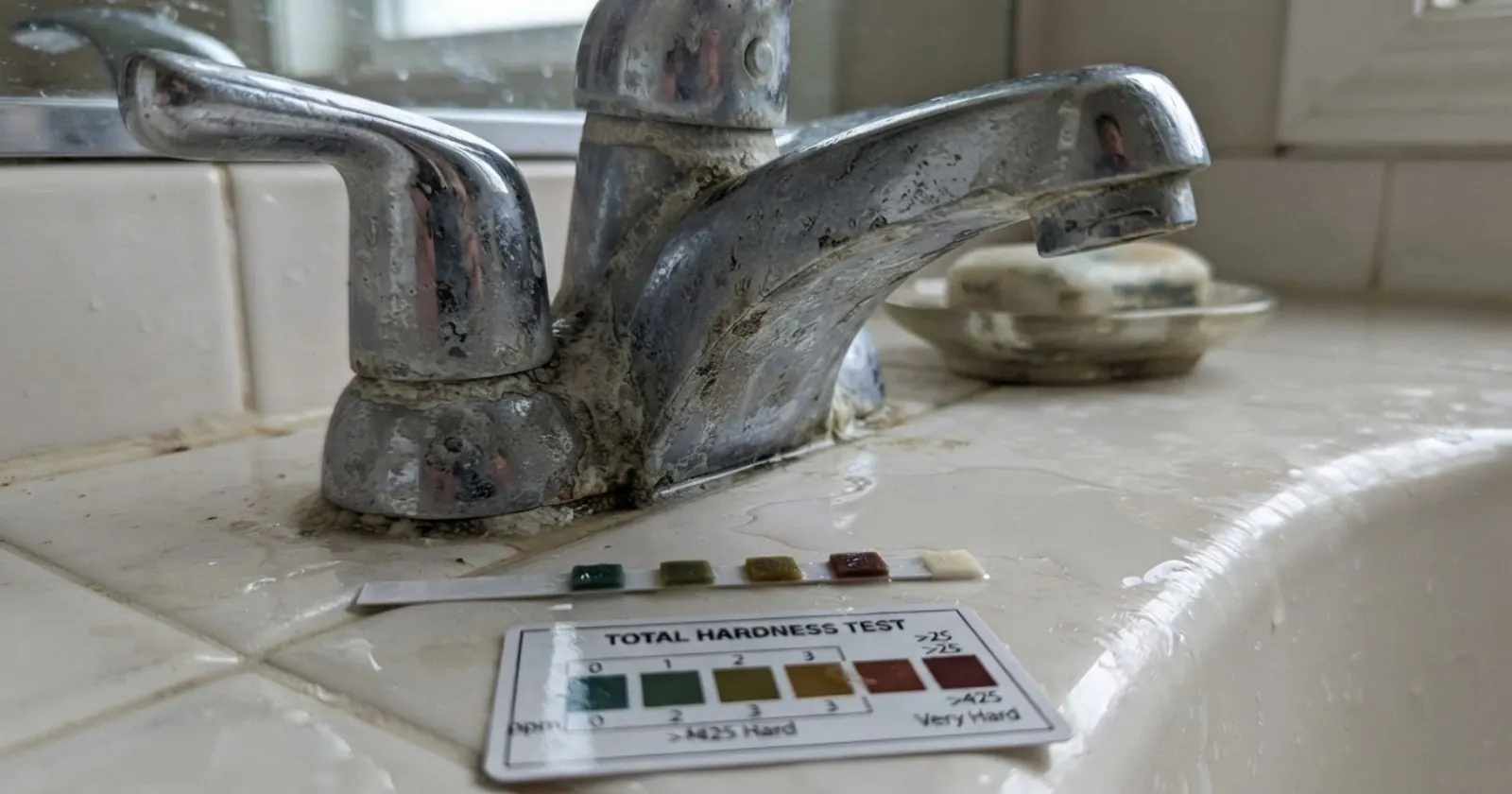
Search for the water hardness in Surprise and you will find numbers that do not agree. One site lists a figure near 5 grains per gallon. A softener seller claims 15 to 25. A neighbor swears their water leaves white crust on everything, while a friend across town barely notices it. All of them can be telling the truth, because Surprise does not have a single water supply.
This guide explains where the differences come from, how to read the report for your own supplier, and how to turn one number into a softener that is the right size for your house instead of the biggest one on the showroom floor.
Why Surprise has more than one hardness number
Water in Surprise comes from different systems depending on your neighborhood. In EPCOR's Agua Fria district, the supply is a mix of river water delivered by the Central Arizona Project canal, water released from Lake Pleasant, and groundwater pumped from 15 wells. The City of Surprise runs its own systems, including Mountain Vista, which draws only groundwater from 16 wells, and a separate system called Desert Oasis.
Surface water and groundwater carry different amounts of dissolved calcium and magnesium, the two minerals that make water hard. A blended supply can also shift over the year as the utility changes how much of each source it uses. So a hardness reading from a friend on a different system, or even a reading from your own tap last spring, may not match what is flowing today.
Step one: find out who supplies your water
The quickest check is your water bill. The name at the top tells you whether you are an EPCOR customer or a City of Surprise customer. Some EPCOR water customers still get sewer service from the city, so you may have two bills from two different providers. The water bill is the one that matters here.
Each supplier publishes an annual water quality report, sometimes called a Consumer Confidence Report. It lists what was measured in the water, and many reports include a hardness figure or a range. That range is your starting point, not your final answer.
Step two: convert the number to grains per gallon
Water reports often list hardness in milligrams per liter or parts per million, which are the same thing for this purpose. Softeners are sized in grains per gallon. To convert, divide the ppm figure by 17.1. A report showing 171 ppm works out to 10 grains per gallon.
| Water Quality Association band | Grains per gallon | What you will notice |
|---|---|---|
| Soft | 0 to 3.5 | Little or no spotting on glass or fixtures. |
| Moderately hard | 3.5 to 7 | Spotting on glassware and gradual scale in the water heater. |
| Hard | 7 to 10.5 | Crust on aerators and showerheads, and soap that does not lather well. |
| Very hard | Over 10.5 | Fast buildup, frequent tankless descaling, and short fixture life. |
Step three: test at your own tap
A utility report describes water as it leaves the treatment plant or wells. It does not know about your home. An inexpensive hardness test strip or a drop-count kit gives you a reading at your kitchen faucet in a few minutes. A plumber quoting a softener should test too, and it is fair to ask to see the result.
Test the cold water, not the hot. If you already have a softener, test at an outdoor hose bib that bypasses it, since softened water will read near zero and tell you nothing about the incoming supply.
Step four: size the softener
Softener capacity is measured in grains, meaning the total hardness it can remove before it needs to regenerate. To estimate what you need, multiply three numbers: the hardness in grains per gallon, the number of people in the home, and the gallons each person uses per day. A common planning figure is about 75 gallons per person per day.
For a household of four with 12 grain water, the math is 12 times 4 times 75, or 3,600 grains per day. Most people size a softener to regenerate every several days rather than daily, which saves salt and water. At 3,600 grains per day, a unit with around 30,000 grains of usable capacity would regenerate roughly once a week.
| Household | Hardness | Daily grains removed | A sensible capacity range |
|---|---|---|---|
| 2 people | 8 gpg | About 1,200 | Smaller units, around 24,000 grains. |
| 4 people | 12 gpg | About 3,600 | Mid-size units, around 32,000 grains. |
| 5 people | 15 gpg | About 5,600 | Larger units, around 40,000 grains or more. |
These are planning figures, not a quote. Water use, iron content, and the efficiency setting of the control valve all change the right size. The point is to size from your own reading, not from a guess about the whole city.
Why bigger is not always better
An oversized softener regenerates so rarely that the resin can sit in stagnant water for long stretches. An undersized one regenerates constantly, which burns through salt and sends extra brine down the drain. The goal is a unit that regenerates on a steady schedule, often every five to eight days for a typical family.
The control valve matters as much as tank size. A metered, on-demand valve regenerates based on actual water used, while an older timer-based valve regenerates on a fixed schedule whether you used water or not. For most Surprise homes, a metered valve is the better choice.
Where the softener goes in a Surprise home
Many homes built here in the last 30 years have a softener loop in the garage. It is a pair of capped pipes near the water heater that lets a softener treat indoor water while the outdoor hose bibs stay on hard water. That setup keeps softened water off your landscaping and saves salt.
The unit also needs a drain for the brine discharge and, in most cases, a nearby outlet for the control valve. The IPC requires the brine drain to empty through an air gap so waste water cannot be pulled back into the supply.
Signs your current softener is set wrong
- Spots and crust come back even though the brine tank has salt.
- Water feels slippery long after rinsing, a sign the hardness setting is higher than needed.
- Salt use seems very high for the size of your household.
- The brine tank has standing water well above the salt line.
- Your water heater still pops and rumbles after a year of softening.
Most of these point to a setting problem or a maintenance issue rather than a failed unit. Resetting the hardness and regeneration schedule to match a fresh tap test often fixes them. If the resin is worn out or the valve has failed, a softener repair or replacement is the next step.
Softener or filter?
A softener removes hardness minerals. It does not remove chlorine taste, odor, or most other contaminants. If your main complaint is how the water tastes, a carbon filter or an under-sink reverse osmosis system may be what you actually want. Many homes end up with both, and our page on water filtration installation covers how they fit together.
Next door, El Mirage homeowners can find that suppliers change from one neighborhood to the next, so test before sizing there too.
The short version
- Check your water bill to see which supplier serves your address.
- Read that supplier's annual water quality report for a hardness figure.
- Divide any ppm number by 17.1 to get grains per gallon.
- Test your own cold tap to confirm it.
- Multiply hardness by people by about 75 gallons to estimate daily grains.
- Choose a unit that regenerates every several days, with a metered valve.
Following those steps gives you a softener that fits your water, your household, and your budget. It also protects the appliance that suffers most from hard water in this area, the water heater sitting in your garage.
Need a plumber in Surprise?
Want a hardness test at your tap and a softener sized to it? Call for a free estimate.
Call (623) 301-9042